
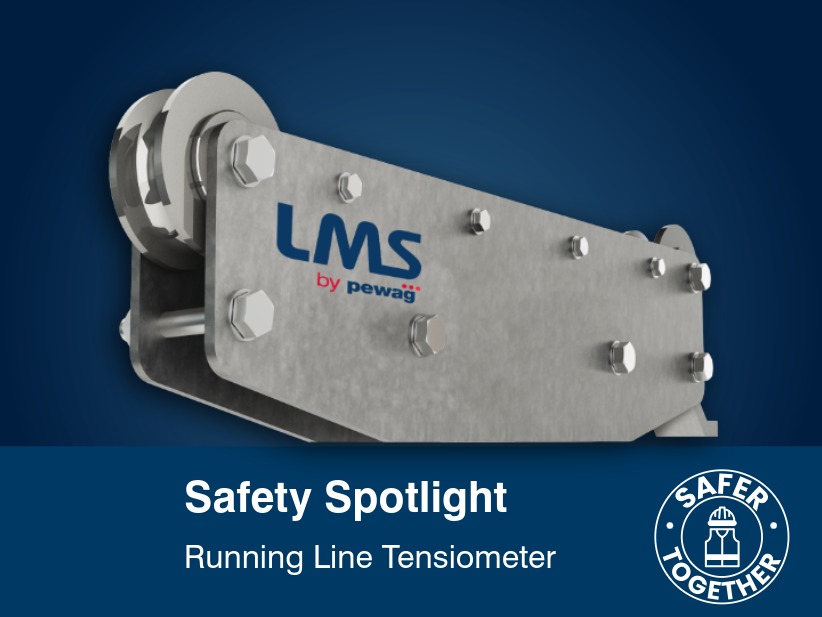
How real-time tension monitoring protects people, lines and equipment when loads will not stay still.
In winching, towing, laying and tensioning operations, the most dangerous load is rarely the one you planned for. It is the one that arrives without warning. A line that is comfortably within its working limit one second can spike well beyond it the next, driven by a snag, a sudden sea state, a stalled payout or a shock release of stored energy. These dynamic loads are the central safety problem that a running line tensiometer is built to address.
Unlike a static load cell rigged to a dead end, a running line tensiometer (RLM) measures tension on a line that is moving (paying in or out under power) and reports it continuously. That distinction matters enormously for safety, because it is precisely during movement that tension behaves least predictably. This article looks at why dynamic loads are so hazardous, how an RLM mitigates the risk, and where the device sits within a wider duty of care under UK lifting legislation.
The Problem: Why Dynamic Loads Are So Dangerous
A working line under steady tension is a relatively well-understood system. The risk profile changes the moment that line is in motion and the load can fluctuate. Several mechanisms turn an ordinary operation into a hazardous one:
- Shock loading. A line that snags and suddenly frees — or a load that is checked sharply — can momentarily generate tension far in excess of the steady-state value. Synthetic ropes and wire ropes both have a finite capacity to absorb this energy before something yields.
- Snagging and fouling. In cable laying and subsea work, a line can catch on the seabed, a structure or its own guide system. Tension climbs rapidly and, if the obstruction releases, the stored energy is discharged in an instant.
- Environmental input. Offshore, vessel motion, swell and current feed continuously varying load into mooring and towing lines. The peak tension may occur in a trough or on a roll that no operator can anticipate by eye.
- Payout and speed effects. The rate at which a line is paid in or out changes the dynamic forces in play. Acceleration and deceleration both add to the static load.
The common thread is unpredictability. A worker watching a winch drum cannot see tension; they can only see motion. By the time a problem is visible (a line jumping, a sheave deforming, a parting strand) the safe window to react has usually already closed. A parting line under high tension releases energy violently and is a recognised cause of serious and fatal injury in marine and lifting environments.
The Solution: Continuous, Real-Time Tension Monitoring
A running line tensiometer removes the guesswork by turning an invisible, fluctuating force into a live, readable value. The principle is mechanical and robust: the line is threaded through a set of sheaves arranged so that the running line is deflected slightly as it passes the central load-sensing sheave. The force required to hold that deflection is proportional to line tension, and a load pin within the sheave assembly converts it to a signal that the operator can read in real time.
Because the measurement is taken on the line itself, an RLM works where a conventional dead-end dynamometer cannot: on a continuously moving rope with no accessible fixed end. That capability is the reason these instruments are specified for winch control, crane work, towing, mooring, pipe-lay and subsea operations across marine, offshore and onshore industries.
From Measurement to Active Protection
Monitoring tension is only half of the safety value. The decisive feature is what the system does with the reading. A modern RLM setup gives the operator:
- Live tension, speed and payout. Operators see not just the current load but the rate of change and the line distance moved, so a trend toward an unsafe condition can be caught while there is still time to act.
- Configurable over-load and under-load alarms. Rather than relying on a person to spot a number crossing a threshold, the system itself flags the breach. This shifts protection from human vigilance — which fatigues — to an engineered control that does not.
- Remote read-out. Wireless telemetry lets the operator stand well back from the line, outside the snap-back danger zone, while still reading tension clearly. Keeping people away from a line under load is one of the simplest and most effective risk controls available.
- Data logging. A recorded tension history supports incident investigation, demonstrates that loads stayed within limits, and feeds into the documented evidence trail that a competent person relies on.
LMS running line tensiometers are designed around exactly this safety-first philosophy — ruggedised and marinized for the most extreme offshore environments, fitted with a Quick Release System with no Tools Required, available across line diameters from 8mm to 104mm + and capacities up to 250Te, and matched with telemetry displays, data-logging software and output options that records every reading. See the full Running Line Tensiometer range for the design and capacity options.
A Safety Device, Not a Scale
It is important to frame the RLM correctly. Although it converts line tension into a weight or force reading, it should be treated as a safety instrument rather than a trade scale. Its purpose is to keep an operation inside safe limits, not to certify a precise commercial weight. Two practical consequences follow from this.
First, accuracy depends on the installation. Sheave condition, line type and diameter, and the way the device is mounted all influence the reading. A reading that drifts unnoticed is arguably more dangerous than no reading at all, because it breeds false confidence.
Second, the device must be correctly anchored. A running line tensiometer is restrained against a fixed point so it does not travel with the line, while a swivel or tether arrangement allows it to align freely without interfering with spooling. Poor mounting both corrupts the reading and introduces its own mechanical hazard.
Conclusion
Dynamic loads are dangerous precisely because they defeat the eye. Tension is invisible, it moves quickly, and the consequences of a breach (a parted line, damaged equipment, injured people) are severe. A running line tensiometer makes that hidden force visible and, with configurable alarms and remote read-out, turns visibility into action before conditions become unsafe. Treated as the safety instrument it is, kept calibrated, and integrated into a proper system of work, it is one of the most effective ways to keep winching, towing and tensioning operations under control.
Frequently Asked Questions
What is a running line tensiometer used for?
A running line tensiometer measures the tension on a moving rope or cable in real time. It is used in winch control, crane, towing, mooring, cable laying and tensioning operations — anywhere the load on a line in motion needs to be monitored to keep it within safe limits.
How is a running line tensiometer different from a dynamometer?
A conventional load cell or dynamometer is rigged into a fixed, dead-ended point and reads a static load. A running line tensiometer measures tension on a continuously moving line that has no accessible dead end, which is why it is the correct choice for winching and payout applications.
Why are dynamic loads more dangerous than static loads?
Static loads are predictable; dynamic loads are not. Snagging, shock release, vessel motion and changes in payout speed can drive tension well beyond the steady-state value in an instant, often faster than an operator can see or react to. Continuous monitoring with alarms is the practical defence.
Does a running line tensiometer need calibration?
Yes. Because accuracy depends on site-specific factors such as sheave condition, line type and mounting, the device should be calibrated to the specific requirements needed in the field each time the requirement changes. It should be treated as a safety instrument rather than a trade scale.
To learn more about our Load Pin Shackles or to request a quote, please contact the sales team:
To discuss the right running line tensiometer configuration for your application, contact Load Monitoring Systems on +44 (0) 1224 446100 or lms@loadmonitoringsystems.com or visit www.loadmonitoringsystems.com